
Gas Gas EC300: how Rigo Racing prepared it for Superenduro
Rigo Racing details the suspension, chassis and two-stroke engine changes made for the 2026 EICMA course.

2 min read

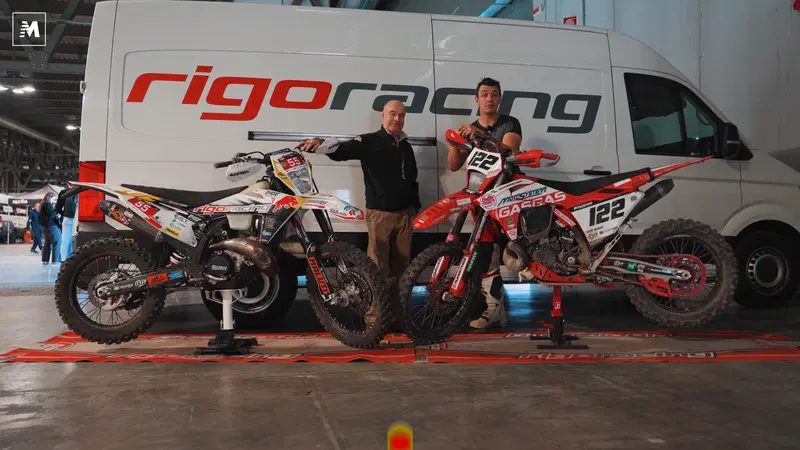
The 2026 EICMA Superenduro combined supercross jumps with two sand sections, logs, tanks and an exceptionally long rock-strewn sector. The course was faster than expected but retained an unusually high technical level. Riders and teams representing more than 25 world titles were present, including Steve Holcombe, Morgan Lesiardo, Riccardo Fabris and TM with Zach Pichon. Rigo Racing used the event to show how its Gas Gas EC300 had been prepared, with the focus placed on the engineering choices that suit this type of terrain.
A chassis designed to manage the rocks
Marco Rigo describes a different approach to the Austrian machines, with ProLink associated with the Husqvarna platform and TBI arriving on the Gas Gas from 2024. In his explanation, PDS provides about 20% more progression in a linear distribution, while the linkage system reaches roughly 80% through a progressive action. Rigo places the PDS advantage up to 40 km/h and the linkage advantage above that threshold. The rear suspension uses springs harder than the table values, along with hydraulics intended to absorb the impacts. The cast-aluminium mounts between the frame and engine are replaced by stainless-steel sheet brackets, reducing the rigidity of the frame compared with its previous state. That lets the front end absorb hits from the rocks without passing them into the rear. Lower, rear-set footpegs and a chain guide that limits free movement and prevents the chain from falling complete this part of the preparation.
Low-rev engine response
The engine receives a sand-cast cylinder head instead of a head machined from solid ergal, a solution described as more vulnerable to detonation. The chosen head provides rigidity and heat dissipation and, according to the technical explanation, doubles power between 2,000 and 3,000 rpm. Its delivery therefore approaches that of a four-stroke engine in this range. Greater flywheel mass is considered essential to make that character usable: it strengthens traction and drive, while helping the Gas Gas EC300 climb steep sections with the so-called “elevator” effect. The package is consequently aimed at maintaining forward motion and control over demanding rock sections, rather than focusing only on peak power.
THE STORY IN PHOTOS
2 photos
THE EVIDENCE BEHIND THE STORY
Sources
Spotted something that needs correcting? Contact the editorial team