
Nearly ten years on the road with a Honda CT110
Liam Della set out on an 18-month world tour. In November 2026 he is still in Texas, with Tierra del Fuego next on the route.

6 min read
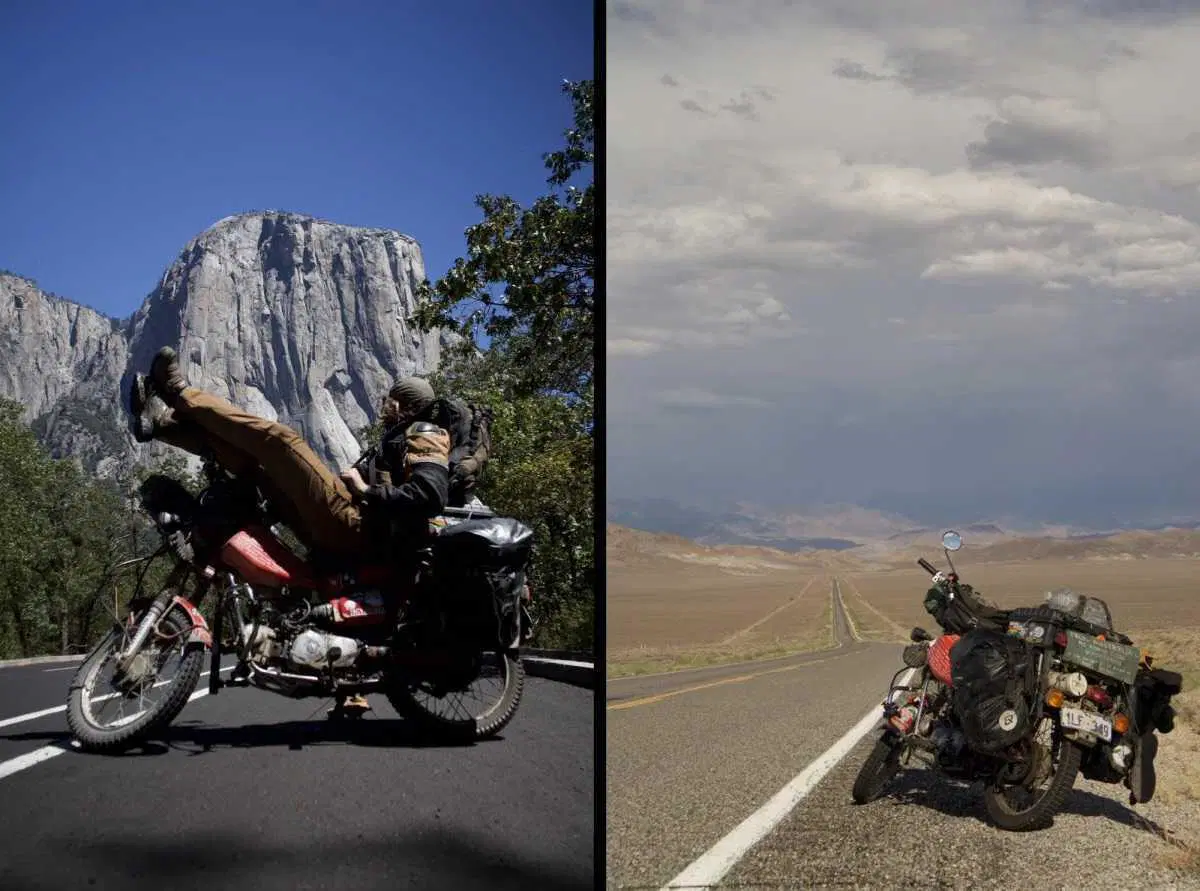
In April 2017, 23-year-old Liam Della left Perth, Australia, with a clear but ambitious plan: complete a round-the-world motorcycle journey in 18 months. His choice of machine was unconventional. Instead of a large adventure motorcycle, he bought a red Honda CT110 for 600 dollars. Nearly ten years later, Della is still travelling on that same motorcycle. In November 2026 he is in Texas, preparing to head towards Tierra del Fuego before the CT110 is returned to Australia.
The CT110 is an unusually simple tool for such a long journey. Its air-cooled 105 cc single-cylinder engine works through a four-speed gearbox, while its practical equipment includes a large rack and a front basket. In several countries it is known as a postie bike, the utilitarian model used for decades by Australian postal services on paved roads and dirt tracks. It appeared in 1980 as the successor to the CT90 and belongs to the wider family linked to the Super Cub. Its modern relative is the CT125 Hunter Cub.
The importance of Della’s choice is not limited to the price or the modest specification. A small motorcycle changes the pace of a journey. It cannot cover long distances quickly or provide the carrying capacity of a large touring machine, but it places the rider closer to the road and the people along it. Della’s experience challenges the assumption that a major adventure automatically requires a major motorcycle.
The first routes and the forced pauses
The first leg took Della through Australia, the Indonesian archipelago, Malaysia, southern India and roughly a dozen countries across South Asia. He says he fell about a dozen times in Indonesia while learning to deal with the local traffic. By his account, the CT110 itself caused very few mechanical concerns. At one of his first gatherings with long-distance travellers, he heard a planning rule that proved remarkably relevant: take three times the money you think you will need and allow twice the time you have planned.
In Malaysia he met his partner. They continued together until Nepal, where they decided to become a couple, and the journey then stopped. The CT110 was shipped back to Australia. What followed included six months in New Zealand, a low-cost flight to Indonesia, a north-to-south journey through Vietnam on a rented Honda 70 cc and a full year of work to save money. The original itinerary had already become a direction rather than a fixed timetable.
Della set off again in 2019 with his partner, each riding a CT110, travelling from Australia towards Turkey. They reached Turkey, but the pandemic and the successive closure of borders forced them to return to Australia, leaving the motorcycles there. The next restart came in January 2025. This time Della had no motorcycle with him: he took trains from Kuala Lumpur to China and then crossed Asia by hitchhiking until he reached his old Honda in Turkey.
From Turkey to Bonneville
Once reunited with the CT110, Della crossed Europe by deliberately choosing a route that was far from direct. He passed through Croatia, Paris, southern Ireland and northern Italy before continuing to the United States. In rural Saskatchewan, the old Honda kept him there for five weeks while he waited for spare parts. The delay also led to one of the defining encounters of the journey: a local family had seen him pushing the motorcycle along the highway and invited him into their home.
Later, in the Bonneville area, Della met a rider involved in land-speed record attempts on the salt flats. His gloves had been stolen before he reached Utah, but the new meeting quickly turned into practical cooperation. He found a place to sleep and joined the pit crew. Over the following two days, he and the rider achieved a speed record. The scene captures the unusual logic of Della’s journey: a rider who arrived on a postal-delivery motorcycle ended up helping a team chasing performance on the salt.
The Bonneville rider is now hosting Della in Texas and plans to accompany him to Argentina. The next stage, from Texas to Tierra del Fuego, is expected to take six to twelve months. After that, the CT110 will have to be shipped back to Australia, while Della will cross the country again to return it. For the Darién Gap, the roadless region between Panama and Colombia, he is considering travelling by sea. If that is not practical, he will take a plane.
When the road rewrites the plan
Della describes repeated generosity from strangers he met along the way, while acknowledging that some routes he used in the past are now closed by conflict and bureaucracy. For him, destinations provide direction but are not the centre of the journey. What matters is the people encountered and the person the traveller becomes along the way. He sums up his approach with the words “connection, presence and acceptance” and says he is proud to have set off without knowing what awaited him.
That outlook is why his story is relevant even to riders who have no intention of reaching Patagonia. Della sees adventure as an expansion of one’s horizons, whether that means travelling a few kilometres from home or crossing half the planet. He argues that seeing things with your own eyes has a value that cannot be replaced by someone else’s perspective. Breakdowns, closed borders, delays and even a stolen pair of gloves were not simply obstacles; they created encounters that a tightly controlled itinerary would never have produced.
After the last 18 months of continuous travel, Della admits to feeling mentally tired. The duration has an added irony, because 18 months was the period he originally allowed for the entire world tour. Nevertheless, the journey continues. Its next major chapter is the descent towards Tierra del Fuego, followed by the transport of the motorcycle and its eventual return to Australia.
The idea that follows is even less predictable: an old English limousine, full of friends, driven from England to Cape Town. After almost ten years on a Honda CT110, the plan suits a traveller who has already watched every timetable change shape. In Della’s case, the plan was enough to get moving; the meetings, delays and the road itself decided what came next.
THE EVIDENCE BEHIND THE STORY
Sources
Spotted something that needs correcting? Contact the editorial team