
Triumph Street Triple 798 RS: a racing kit before a Daytona?
Triumph has opened the door to an official track package for the 135-CV 798 RS, while a road-going Daytona 798 remains unconfirmed.

5 min read
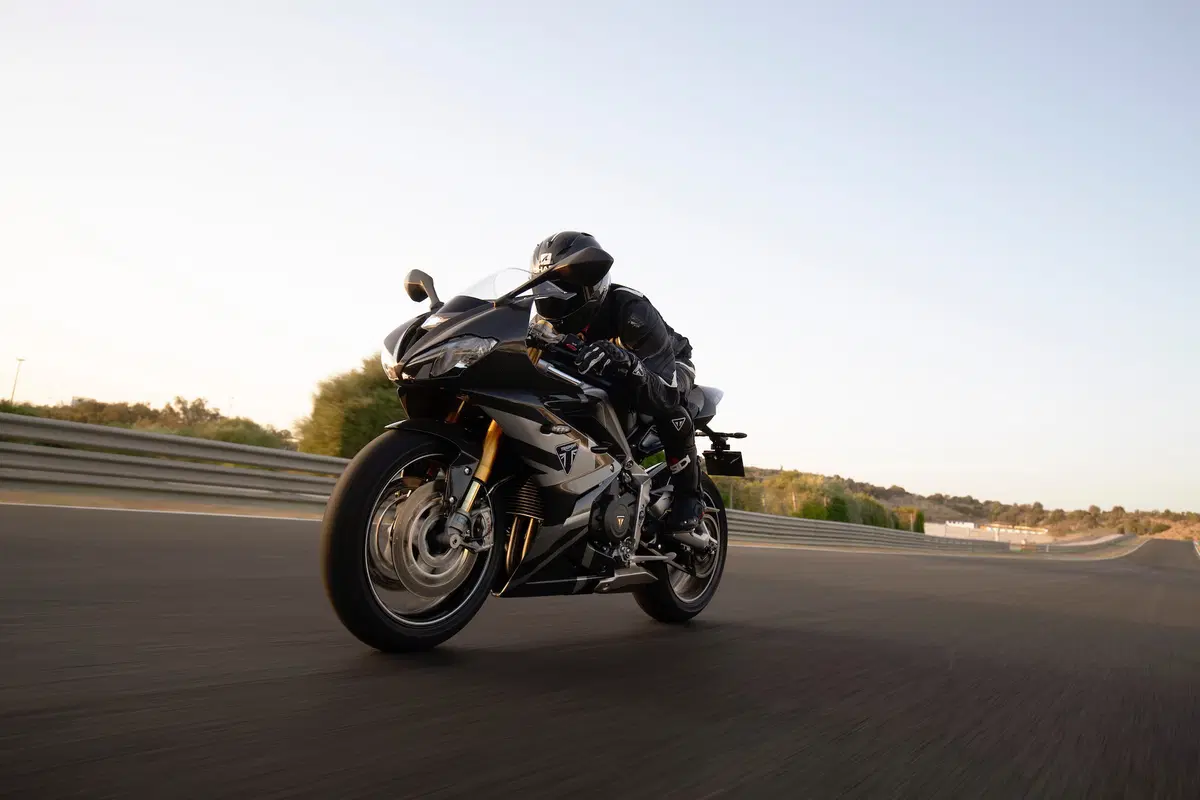
Triumph has not confirmed a production Daytona 798, but the company has opened a more immediate route to a sharper version of its new naked motorcycle. During the presentation of the Street Triple 798 RS, Triumph representatives indicated that an official accessory package designed exclusively for circuit use could be on the way. The proposal is not a new road-legal sportbike announcement; it is a possible factory-backed transformation for the 798 RS.
The suggested package would go well beyond cosmetic add-ons. Triumph’s track-focused accessories could include low clip-on handlebars, adjustable rearsets and a complete set of racing fairings. In practical terms, that would give owners the principal components needed to move the Street Triple’s riding position and appearance toward a fully faired supersport layout, without the company first committing to a separate Daytona in its regular range. The timing and final specification of such a package have not been confirmed, so it should be treated as a possibility rather than a product launch.
A strong platform for the idea
The technical basis is the Street Triple 798 RS, unveiled in November 2026 with an all-new 798 cc three-cylinder engine. Triumph quotes 135 CV at 11,500 rpm and maximum torque of 86 Nm at 9,250 rpm. The engine uses a low-inertia valve train, DLC-coated rocker arms, more aggressive cam profiles, larger valves and a 13.5:1 compression ratio. Those details do not turn the naked bike into a Daytona by themselves, but they explain why the platform invites speculation about a more focused derivative.
Triumph also connects the engine’s development with more than two million kilometres accumulated during its role as the sole engine supplier in Moto2. The Street Triple 798 RS combines that three-cylinder unit with a new aluminium perimeter frame, while its running order weight is listed at 183 kg. A steeper steering-head angle and reduced trail are part of the chassis changes intended to sharpen responses and make direction changes more precise. On a fully faired motorcycle with clip-ons, that same starting point would support a considerably more committed circuit character.
The equipment list strengthens the argument. The 798 RS is specified with Brembo Stylema calipers and a 7-inch colour TFT touchscreen that incorporates a lap timer. Add racing bodywork, lower handlebars and adjustable rearsets, and the motorcycle would have the key ingredients for a serious track-day configuration. That is a technical reading of the platform, not a claim that a tested Daytona 798 already exists. Nor does it confirm the arrival of a production fairing kit; Triumph has only opened that possibility through the presentation discussion.
Triumph has used the formula before
There is a clear precedent in Triumph’s recent treatment of its three-cylinder platforms. The previous generation produced special versions with a pronounced racing identity, including the Street Triple Moto2 Edition and the RX. The Moto2 Edition was equipped with clip-on handlebars from the factory, while the RX borrowed the sharply shaped rear section of the Daytona road bike. Those motorcycles showed how Triumph could give an existing naked platform a more specialised role without necessarily creating an entirely separate family of engines and chassis.
The new 798 therefore provides a credible foundation for another limited or track-oriented interpretation, but the shape of that interpretation is still open. It could remain an accessory programme centred on the racing fairings and control changes, or eventually provide the inspiration for a more complete special edition. A new Moto2 Edition with dedicated upper hardware and clip-ons is one possible direction, while styling influenced by Triumph’s faired motorcycles would be another. Neither option has been announced as a finished model.
From the Daytona 675 to the 765
The persistent demand for a serious new Daytona is rooted in the Daytona 675. That motorcycle became known for the balance of its chassis and the character of its three-cylinder engine, while its racing identity was associated with events including the 200 Miglia di Daytona and the Isle of Man Tourist Trophy. Its narrow, focused design made it an important part of Triumph’s recent sportbike history before the global downturn in the 600 supersport segment led to its departure.
Triumph later revisited the idea with the Daytona Moto2 765 Limited Edition, a short-lived, limited and numbered series. Its exclusivity, higher price and the market’s shift toward other motorcycle categories restricted its commercial reach, but the faired 765 still appealed strongly to riders who wanted a modern Daytona with a clear racing connection. It did not become the widely available, regular-production replacement that some customers expected.
The current answer in Triumph’s faired range is the Daytona 660, listed with 95 CV and 69 Nm. It is positioned as a practical and more accessible road sportbike, and the model has also competed successfully in Italian and European Sportbike championships. A Daytona based on the 798 RS would occupy a different level: it would be more powerful than the 660 and, especially with the proposed track hardware, would represent a much more extreme technical direction.
For now, the most concrete path linked to the Street Triple 798 RS is the possibility of an official racing package. A road-going Daytona 798 has not been confirmed, and the company has not presented final details for the proposed accessories. Even so, the combination of a 135-CV engine, 183 kg running order weight, Moto2-linked development and track-oriented chassis equipment makes the 798 RS a convincing base for the idea. Triumph could give circuit riders an official route to a more aggressive, supersport-style motorcycle without immediately adding another production model to its range.
THE EVIDENCE BEHIND THE STORY
Sources
Spotted something that needs correcting? Contact the editorial team