
GR1T G1: four electric motorcycles from one shared platform
GR1T is developing four versions with 11 kW, removable 6 kWh batteries and first deliveries targeted for 2028.

5 min read

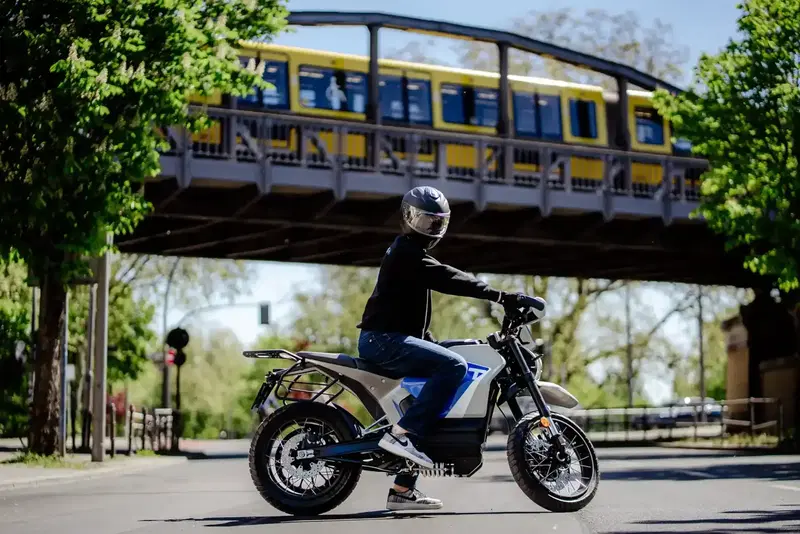
GR1T is taking a modular route into electric motorcycles. Rather than creating four unrelated machines, the company is building the G1 as a common technical base and changing each model’s role through its wheels, tyres, seating and equipment. The family currently consists of the G1S Street, G1X Scrambler, G1XR Raider and G1M Mission. GR1T says that more than 85% of the main components are shared, including the frame, motor, battery packs, belt drive, 17-inch wheels and electronics.
The Street and Scrambler appeared first, while the Raider and Mission extend the range into more specialised territory. The G1 project was designed and developed in Rimini with Wheelab. GR1T Motorcycles GmbH was established in 2023 and is based in Berlin, with founder and CEO Omar Abukhlal leading the company alongside co-founders Philip Ammerman and Jamal Raghei. Its industrial proposition is straightforward: retain the expensive core hardware and adapt the motorcycle around the intended job.
The shared electric hardware
Every G1 uses a brushless motor with internal permanent magnets, radial flux and air cooling. Continuous rated output is 11 kW, while peak power is quoted at 26.6 kW. Continuous torque is 56 Nm and peak torque 85 Nm. Final drive is handled by a 22 mm carbon belt. GR1T quotes a top speed of 130 km/h, a weight of approximately 130 kg with the batteries fitted and a maximum payload of 190 kg.
The battery system comprises two removable 3 kWh packs, giving a combined capacity of 6 kWh. They can be charged on the motorcycle or taken indoors and connected to a household socket. An adapter allows use of public Type 2 charging infrastructure. Charging is quoted at approximately 2.5 hours to reach 80%, and slightly more than three hours for a full charge.
The theoretical urban range is 150 km. Prototype running produced more specific results: 100-120 km in urban riding at speeds up to 60 km/h, and approximately 80 km outside the city at up to 90 km/h. Those figures describe the conditions quoted for the development motorcycles rather than a single universal range figure for every route and riding style.
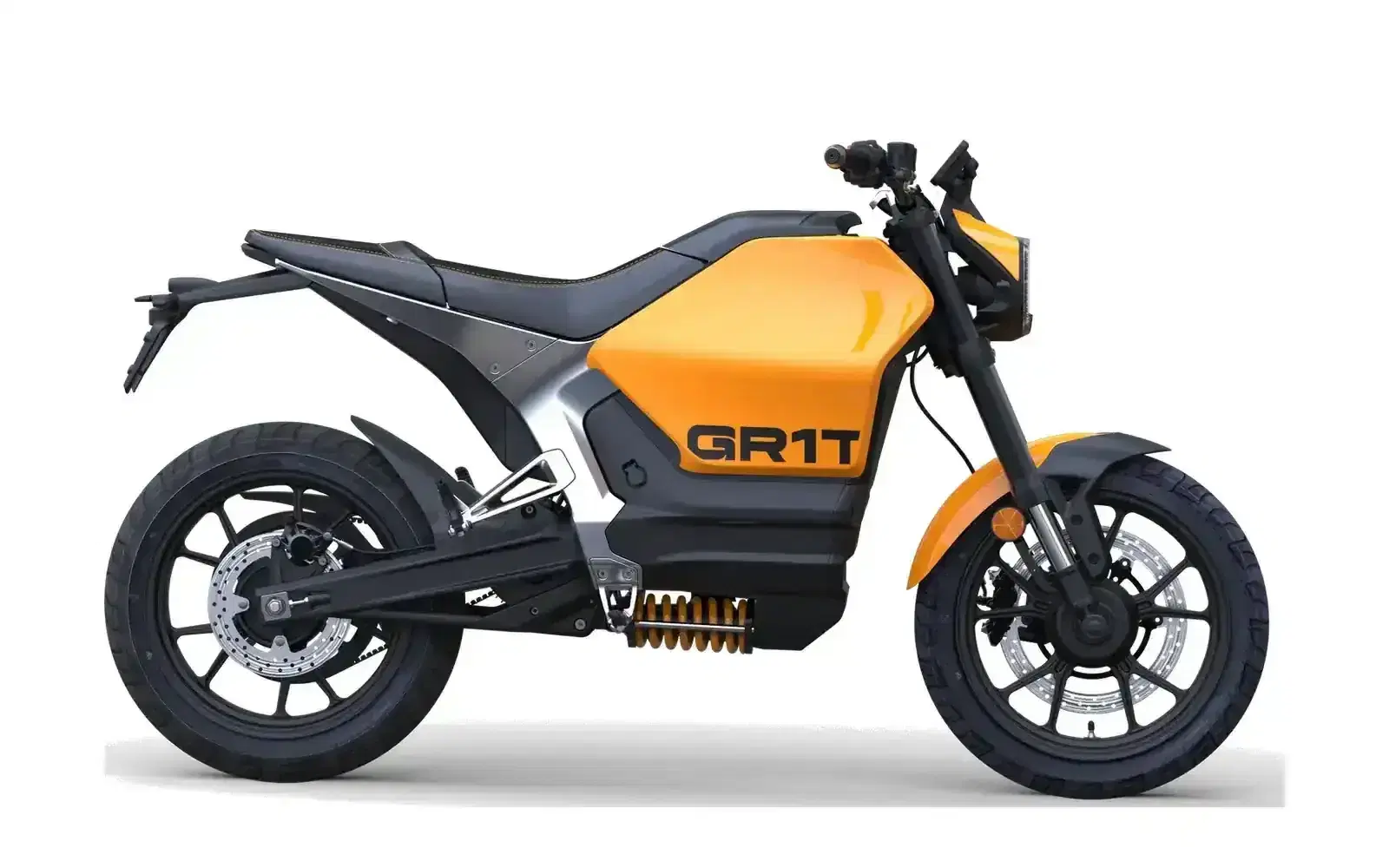
Packaging is another distinctive part of the design. The rear shock absorber sits horizontally beneath the seat, freeing a 9-litre compartment for the charger or small everyday items. Ground clearance is 206 mm on the Street and 228 mm on the other versions. Equipment includes a 5-inch TFT display, wireless Apple CarPlay and Android Auto, GPS, 4G/5G connectivity, keyless start, wireless smartphone charging and front and rear cameras with loop recording. Remote locking and smartphone alerts for unauthorised movement are also included in the described specification.
The riding modes are City, Performance, Walk and Reverse. Regenerative braking is part of the system, as is combined braking, while ABS is planned for the production motorcycles. The modular approach also extends to the accessories: items such as handguards, leg protection and dashboard protection can be moved between versions, and the side panels are designed to be removed and replaced with little effort.
Four versions, four roles
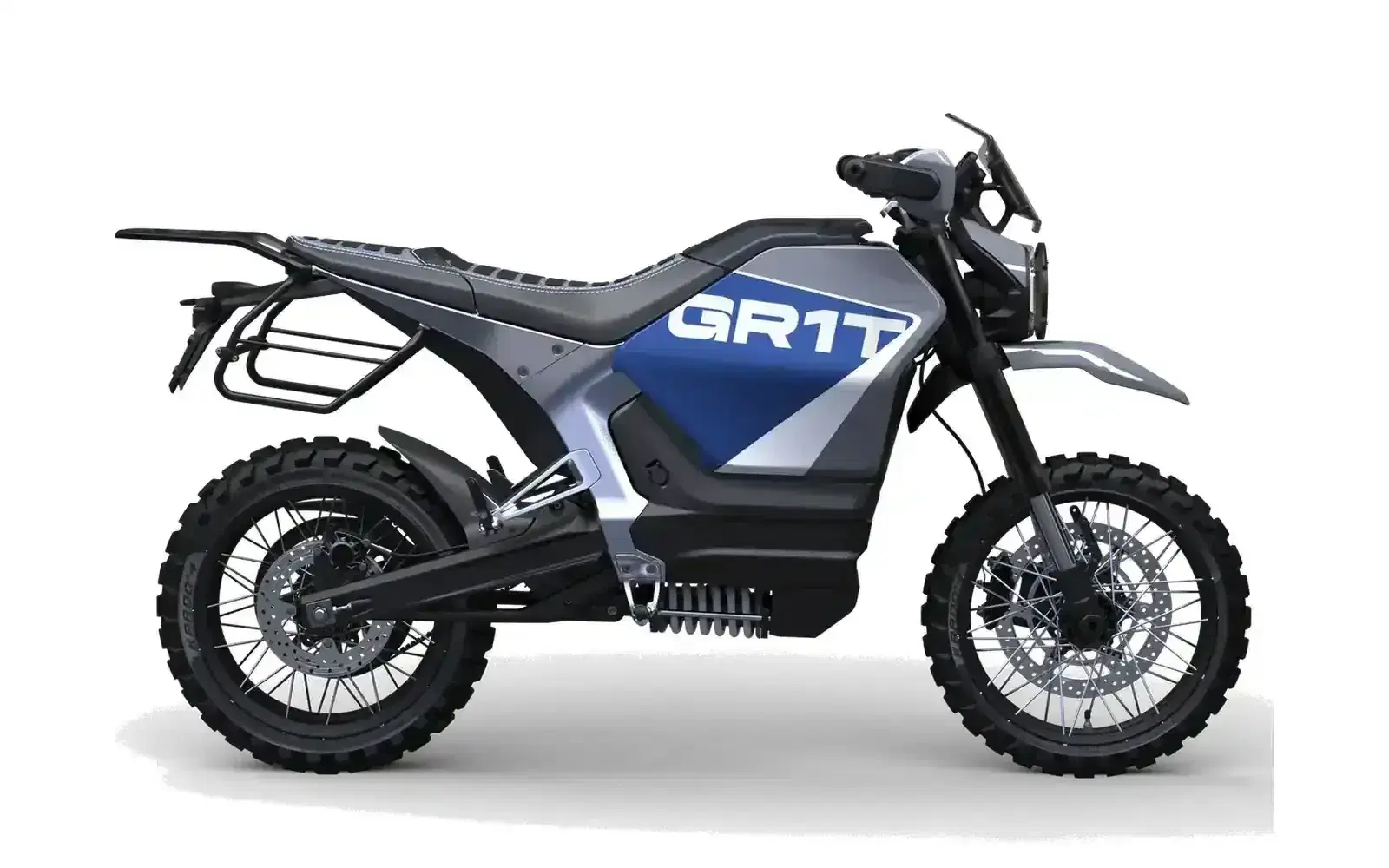
The G1S Street is the simplest member of the family, a city-focused naked motorcycle with alloy wheels and Pirelli Angel City tyres. Its quoted price is 8,495 euros. The G1X Scrambler is listed at 9,495 euros and adds spoke wheels, Metzeler Karoo Street tyres, handguards, a small windscreen, light off-road protection and a luggage rack. Its seat height is 830 mm.
The G1XR Raider is the most expensive version at a quoted 9,995 euros. GR1T positions it for light off-road riding and professional applications including police, fire, rescue and military work. It receives knobbly tyres, reinforced racks, hand and leg protection, auxiliary lights, improved water protection around the drive system and an infrared camera for night use. GR1T also describes shielding for the motor against thermal cameras and the ability to carry additional batteries.
The G1M Mission is aimed at professional users and fleets, including delivery work, sharing operations and vehicles that spend many hours in service. Its quoted price is 9,495 euros. The key change is an extended, replaceable rear frame section that can be configured for a passenger, luggage boxes, a spare battery or heavy-duty side racks. The passenger seat can be removed, allowing the rear of the motorcycle to be set up around the task rather than around a fixed seating arrangement.
Production remains the decisive step
The first running G1 prototype has been on the road since June 2025. Development has already brought one important mechanical change: the original motor was replaced after overheating incidents in more demanding use. Before customer motorcycles can be delivered, GR1T still has to complete final validation and European type approval, organise its supply chain and begin assembly. The company is seeking up to 8 million euros to finance the move into production.
GR1T is targeting first deliveries in 2028, but that is a target rather than a confirmed date. Reservations are open with a refundable 100-euro deposit. The stated commercial offer provides a 1,000-euro discount on the final price, increasing to 1,500 euros for the first 50 reservations. These are the company’s quoted prices and terms; they do not establish Greek pricing or confirmed availability in Greece.
The G1 matters because it combines removable batteries and a relatively compact electric motorcycle with four distinct use cases, without multiplying the underlying mechanical platform. The concept will ultimately be judged by type approval, financing and the ability to build the motorcycles consistently. Until those steps are completed, the G1 is a clearly defined production project in development rather than a mass-produced motorcycle already ready for customers.
THE STORY IN PHOTOS
5 photos

THE EVIDENCE BEHIND THE STORY
Sources
Spotted something that needs correcting? Contact the editorial team