
Why Marc Marquez could retire after 2026 — and why he may not
A 10th world title would complete a major career goal, but Ducati’s contract, Marquez’s winning criterion and his desire to face Pedro Acosta all point the other way.

5 min read
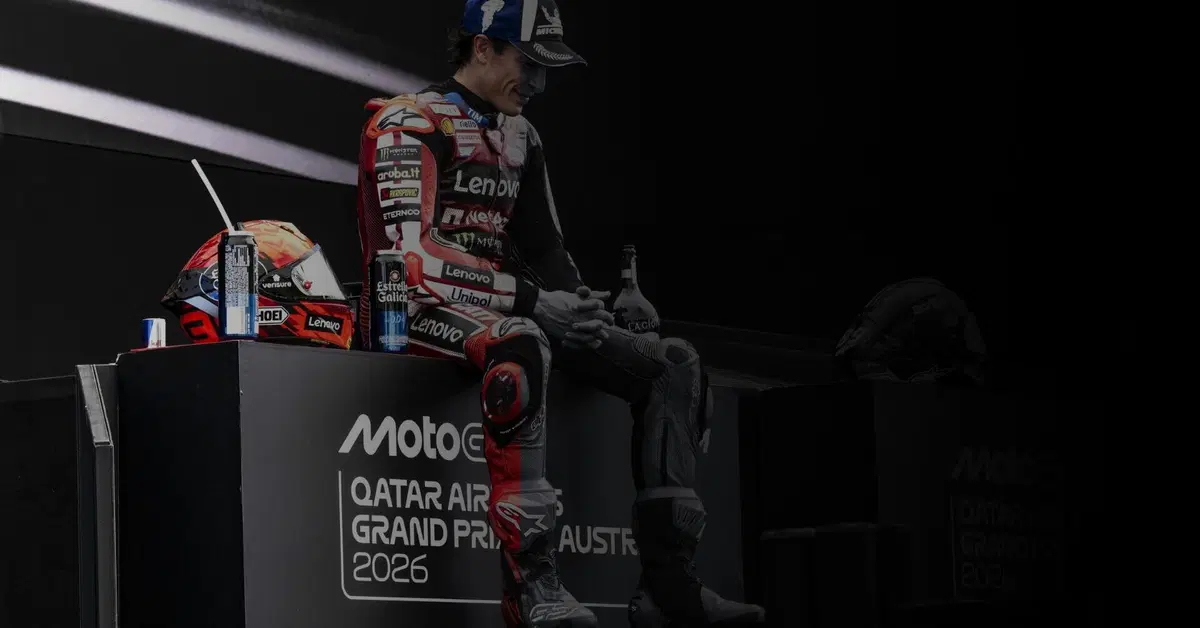
Marc Marquez could theoretically leave MotoGP after the 2026 season with a 10th world title, but retirement is still far from a settled outcome. The argument has two distinct sides: one built around the scale of what he would have achieved and the physical cost of continuing, the other around his Ducati contract and his own stated conditions for stopping. At present, the balance appears to favour Marquez racing on in 2027 and 2028, although his right arm and right shoulder remain the decisive unknowns.
The case for stopping after a 10th title
A 10th world championship would take Marquez into double figures and move him beyond Valentino Rossi’s total. It would also add a different kind of title to his career. The 2025 championship was described as a dominant one, while the hypothetical 2026 crown would represent his first title won after coming from behind. Earlier championships followed different patterns: in 2013 he prevailed in a battle involving Jorge Lorenzo and Dani Pedrosa; 2014 was overwhelmingly dominant; in 2016 he beat Rossi; and in 2017, 2018 and 2019 his main title rival was Andrea Dovizioso. A further championship would therefore give him another distinct achievement rather than simply another number.
The strongest argument for retirement, however, is physical rather than statistical. Marquez’s right arm and shoulder continue to demand attention. His routine includes extensive physiotherapy and push-ups before races, while his physical condition has been characterised as fragile. Continuing would mean confronting an increasingly aggressive Pedro Acosta, potentially on equal machinery, and perhaps having to ride at the limit again to beat him. That calculation matters because Marquez has never been defined by a cautious approach when a victory is within reach. If he decided that another championship campaign posed too great a risk to his health, it would be a defensible decision.
There is also the appeal of ending a career as a winner. Marquez could remain competitive in 2027 yet find himself unable to win against an Acosta in top form. That scenario is considered less convincing as a reason for him to stop: if he still believes he can beat Acosta, competitiveness alone would not be enough to push him away from MotoGP. The physical cost is the argument with the greatest weight.
Why Ducati and Marquez still point towards 2027-28
Ducati’s management has repeatedly presented Marquez’s position as secure. Davide Tardozzi and Mauro Grassilli have referred to a two-year agreement covering 2027 and 2028, with no provision for an early retirement in either 2026 or 2027. Marquez has also said that he will respect the contract. That does not make a change of plan impossible, particularly where health is concerned, but it means that leaving immediately after 2026 would require more than a simple personal announcement.
His own long-standing criterion points in the same direction. Marquez has said that he will stop only when he can no longer fight for victories. He remains competitive in 2026, and the same level could plausibly keep him in contention the following season. The regulation change is not being treated as a compelling reason for him to leave either. His ability to adapt quickly to new situations is widely regarded as one of his principal strengths, so a different technical environment would not automatically alter the decision.
Marquez himself has nevertheless shown how open the question remains. In an interview in Australia, when asked where he saw himself three years later, he gave a personal estimate of 70% for retirement and 30% for continuing. He added that the assessment could change as he evaluates the situation over time. The answer concerned the two seasons immediately ahead, 2027 and 2028; it was not a retirement announcement, but it did show that the possibility is being considered seriously.
His repeated praise for Acosta may also be read in more than one way. Marquez has spoken of the younger rider as someone who could beat him, just as he previously highlighted Francesco Bagnaia’s knowledge of Ducati before eventually taking the spotlight through a run of victories. That does not establish a plan or reveal Marquez’s decision. It could simply be respect for a future rival, or it could reflect a competitive desire to face Acosta and defeat him on track.
If the seat did become available
A Marquez retirement would immediately create a hypothetical succession question at Ducati. Fermin Aldeguer appears the most logical internal candidate, with Nicolo Bulega another possibility, although Aldeguer is the stronger option in this scenario. His promotion would then leave a place at VR46. Manuel Gonzalez could be considered for that seat, while Iker Lecuona is another name in the speculative chain. None of these moves has been decided; they are only the likely consequences of a scenario that remains unconfirmed.
The clearest conclusion is therefore not that Marquez will retire after 2026, but that the choice has a real condition attached to it. A 10th title would offer a powerful finishing point, while the physical demands of another season could make continuation increasingly difficult. Against that stand a Ducati contract through 2028, Marquez’s promise to honour it and his stated wish to continue while he can still fight for wins. Unless his health changes the calculation, the stronger expectation is that he will remain in MotoGP for 2027 and 2028.
THE EVIDENCE BEHIND THE STORY
Sources
Spotted something that needs correcting? Contact the editorial team