
Tardozzi credits Márquez’s race reading as Bagnaia targets Portimao
Ducati’s team manager praises Márquez’s Qatar strategy, explains the team’s recovery from a 102-point deficit and updates Bagnaia’s return plans.

3 min read
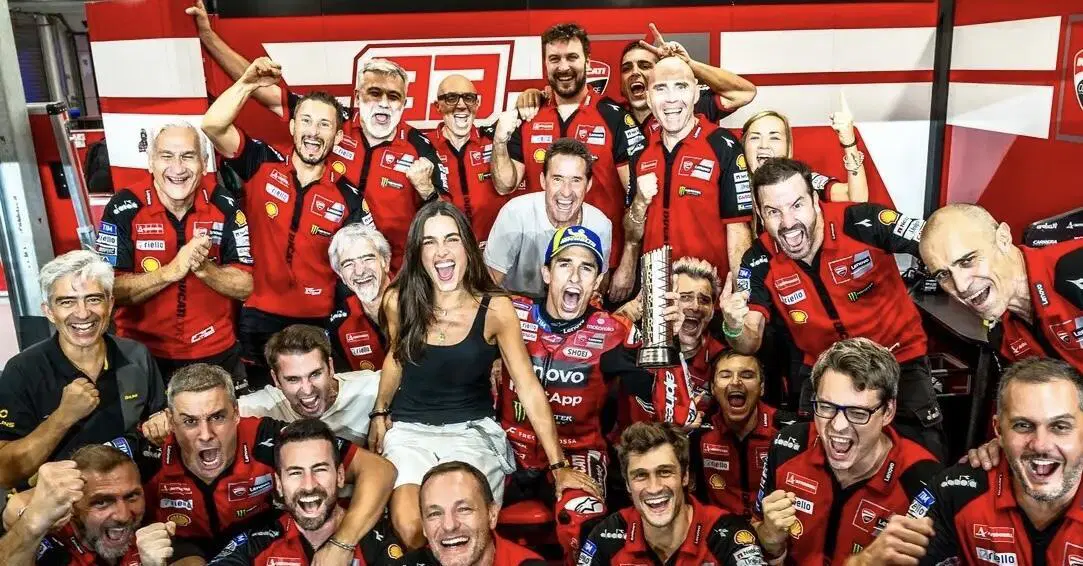
Marc Márquez’s Qatar performance was defined as much by judgment as by speed, according to Ducati team manager Davide Tardozzi. The weekend produced 32 points and reinforced his view that Márquez is now combining his natural pace with the maturity to manage a race according to its changing balance.
Tardozzi said Márquez understood that Marco Bezzecchi had the stronger pace at the beginning. Rather than reacting immediately, the Ducati rider allowed the Aprilia to move away during the opening laps. He then began reducing the gap and attacking the fight for second place around the middle of the race. For Tardozzi, that was evidence of a rider who could assess both his own potential and the advantage held by a rival before committing to a response.
The Ducati manager also pushed back against the idea that the number of motorcycles from each manufacturer explains the result by itself. Four Aprilias and six Ducatis do not decide a race on their own, he argued. Victory depends on the complete combination: a fast rider, a competitive motorcycle, and sporting and technical management that can put that rider in a position to win races and ultimately challenge for the World Championship. Tardozzi also praised Aprilia and Bezzecchi for the competitiveness they showed in Qatar, while noting that another Ducati has occasionally taken a victory.
The Mugello deficit became motivation
Tardozzi returned to the recovery that followed Mugello, where Ducati and Márquez were 102 points behind. He described that deficit as a painful defeat, but also as the motivation that helped the group continue believing in its ability to turn the situation around. The team manager placed particular emphasis on the relationship between Márquez and the Ducati organisation, from Gigi Dall’Igna through to the mechanics. He said the rider had communicated his physical problems openly and clearly, allowing the team to understand that recovery would require months rather than an immediate solution.
Bagnaia’s situation was another central part of Tardozzi’s comments. The Italian missed the Qatar race because of a foot injury and was expected to undergo surgery in Turin, with the procedure planned very soon after his return. Tardozzi said the team wanted to move quickly, but the timing of Bagnaia’s return could not be decided before the operation and an assessment of his postoperative recovery.
Bagnaia’s personal target is to be back for Portimao. That possibility remains dependent on how the recovery develops, while Tardozzi was unequivocal that the Ducati rider will be present at Valencia. He also believed Bagnaia could have finished both Qatar races inside the top five had he been fit to compete. At the circuit, Bagnaia had begun to recover two characteristics he had been seeking: using the rear tyre under braking and carrying speed into the corner. Those gains made his absence particularly frustrating, but they also explain why the team is trying to preserve the possibility of a return as early as Portimao.
THE EVIDENCE BEHIND THE STORY
Sources
Spotted something that needs correcting? Contact the editorial team