
MotoGP Qatar: Marquez wins the weekend, Bezzecchi leads the race-only view
Qatar’s split results show why Marc Marquez has the stronger overall position, while Marco Bezzecchi remains the benchmark when only the Sunday races are counted.

4 min read
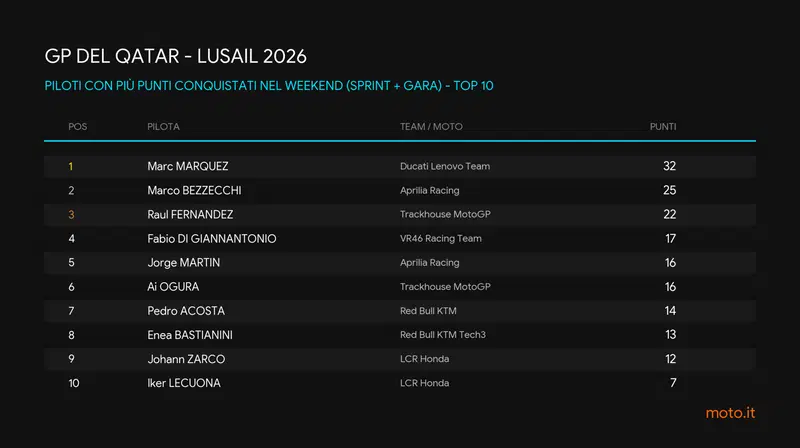
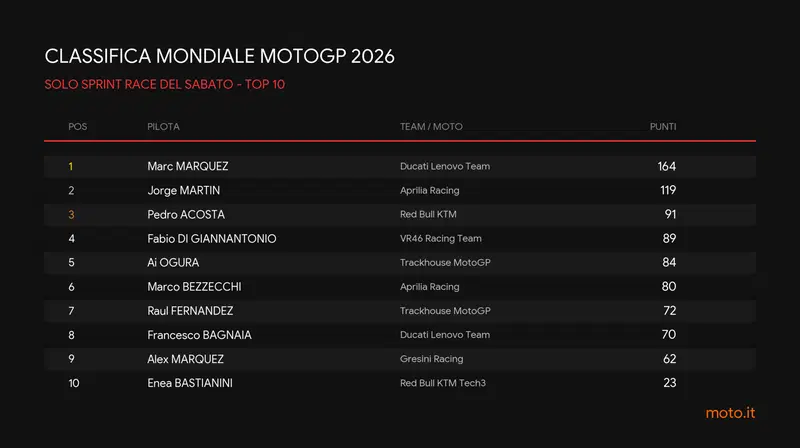
Qatar underlined the importance of MotoGP’s two-race weekend format. Marc Marquez took the highest combined score from the Sprint and the Grand Prix, leaving the event with 32 points and moving closer to a tenth world title. The picture changes when the season is examined through separate calculations: Marquez would lead a championship based only on Sprint results, while Marco Bezzecchi would be ahead if only the longer Sunday races counted.
That contrast gives a more precise meaning to Bezzecchi’s 2026 campaign. His speed has been enough to make him a central figure in the title fight, but the combined classification rewards riders who can convert both parts of the weekend. Qatar therefore strengthened Marquez’s overall position without removing the argument that Bezzecchi has often been the quickest rider when the focus shifts to the main race.
The combined-score table
Bezzecchi has three Grand Prix victories when Sprint and race points are added together: Brazil with 31 points, Italy with 31 and Indonesia with 25. Those three wins give him an average of 29 points. Marquez has eight combined victories, with Hungary at 37 points, Brno at 32, Germany at 37, Aragon at 37, Misano at 37, Japan at 37, Malaysia at 34 and Qatar at 32. His average across those wins is 35.3 points.
Jorge Martin has four combined victories: Texas with 32 points, France with 37, Silverstone with 32 and Austria with 32. His average is 33.25 points. The other four events in this comparison went to Pedro Acosta in Thailand with 32 points, Alex Marquez at Jerez with 25, Fabio Di Giannantonio in Catalunya with 32 and Ai Ogura at Assen with 34.
Australia is excluded from this particular comparison because that event consisted only of a Sprint. The figures do not erase Bezzecchi’s pace; instead, they show how much the shorter race can alter the return from an otherwise strong weekend.
The Sprint clash and Martin’s response
The contact between Bezzecchi and Marquez was the weekend’s most contentious moment. Melandri, Biaggi and Pedrosa assessed it as a racing incident. The available helicopter images showed Marquez using the same line later taken by Di Giannantonio and Martin, who were immediately behind. Bezzecchi entered tightly and at high speed, but the corner could have been completed had Marquez not been occupying that line. Bezzecchi himself chose not to turn the incident into a larger dispute.
Martin produced one of Qatar’s strongest performances. He returned to action just 13 days after the previous event and began the Sprint from 11th place. After the contact, he saw that Marquez’s airbag had deployed and passed him. Marquez quickly reclaimed the position, before Di Giannantonio overtook Martin later in the race. Even so, Martin secured third place in the Sprint, followed by a strong Sunday Grand Prix, making his result especially significant.
Bagnaia’s positive weekend without the reward
Francesco Bagnaia described Qatar as one of the best weekends of his season, despite a final result that failed to reflect the effort behind it. “Sometimes, no matter how hard you try to turn the situation around, things simply do not go as you want,” Bagnaia said, adding that there was nothing he could do about it. His assessment captures the difference between performance and points in a weekend shaped by two separate races.
The MotoGP title was not decided in Qatar, but Marquez left with the strongest overall weekend score and another step toward the championship. Bezzecchi’s lesson is narrower and more useful: the speed required to challenge is present, yet it must be converted more consistently across the Sprint and the main race. That is the gap the combined classifications expose.
THE STORY IN PHOTOS
3 photos
THE EVIDENCE BEHIND THE STORY
Sources
Spotted something that needs correcting? Contact the editorial team