
Marc Márquez takes the cautious route into Portimão’s title weekend
Sixth on Friday and safely through to Q2, the Ducati rider is prioritising control before the decisive sessions and races.

5 min read
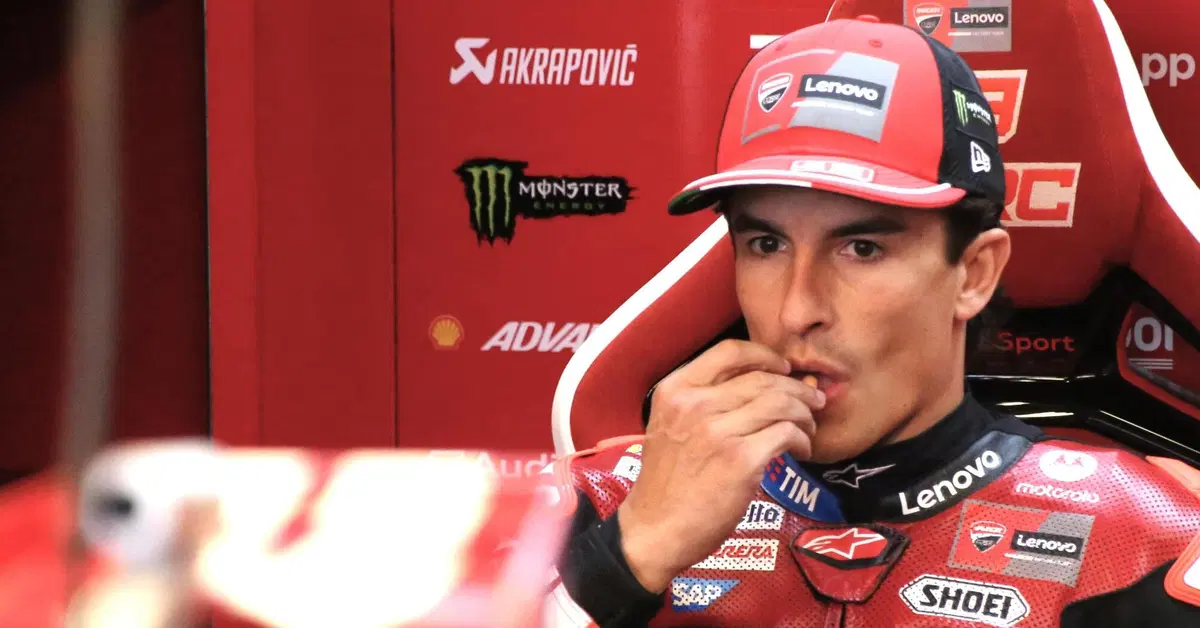
Marc Márquez finished sixth on Friday at the Portuguese Grand Prix and secured direct passage to Q2, delivering the result he considered essential on the opening day. The Ducati rider can become a ten-time world champion at Portimão, but the pressure of that opportunity shaped his approach. Rather than chase a headline lap at any cost, Márquez concentrated on getting through a difficult first day without taking risks that could damage the rest of the weekend.
The championship target is already defined. To clinch the title on Saturday, Márquez needs to gain at least two points on Jorge Martín. His own ideal route is more specific: score one point in the Sprint to eliminate Marco Bezzecchi from contention, then take 14 points in Sunday’s race to settle the situation with Martín. Those figures are Márquez’s plan rather than a prediction of what his rivals will do. He repeatedly stressed that his attention is on the points he can score himself.
A small track problem became a serious warning
Márquez described his physical feeling as heavier and said he was more rigid than at previous Grands Prix. Cold conditions and the need to watch the circuit’s dangerous points made him less relaxed on the Ducati. Portimão is already an unforgiving track when a rider loses momentum through its changes of direction and elevation, and Márquez said mistakes carry a greater penalty there because the flowing sections demand speed and commitment.
The clearest warning came during FP1. On his third lap, Márquez ran wide at Turn 1 and discovered that the green paint was still wet from the previous night. It was not standing water: the paint itself had not dried properly. The green surface contaminated his tyre and he came close to crashing. For Márquez, the incident illustrated how a problem outside a rider’s control can create a major consequence without an obvious riding error. It also reinforced the discipline required during a weekend in which he believes there is more to lose than to gain.
The white lines were also particularly slippery in the morning. Márquez said the combination of low temperatures and those hazards made it easy to make a mistake, while his body gradually loosened during the afternoon. He described finishing Friday with relief—not because it had been a standout performance, but because one more day of risk had passed without the kind of crash that could change the title fight.
Qualifying position matters beyond the lap time
For qualifying, Márquez sees the second row as a realistic target, although he is aiming for the front row. He expects the time attack to require a greater degree of risk than Friday’s running. A strong qualifying lap would have a practical value beyond prestige: it would reduce the pressure to ride aggressively in both the Sprint and the main race. His stated objective is therefore not simply to be fast, but to put the Ducati in a position that makes the points calculation safer.
Márquez has experienced a similar mental burden before. He recalled that, after winning a title last year, he was injured in the following race and missed four events. He also said he rode less perfectly at Motegi when a championship was still some distance away, while the need to take risks felt clearer when the title was decided at the final race. With the advantage already in hand, he explained, the rider can feel that there is only something to lose. That tension leaves his mind constantly working through the possible consequences.
The numbers give him a structure for managing that pressure. One Sprint point would remove Bezzecchi from the mathematical battle in Márquez’s ideal scenario, while 14 points on Sunday would take Martín out of it as well. The Ducati rider presented this as a preferred plan, not a guarantee, and kept the focus on his own results rather than on waiting for the other riders to fail.
Márquez says the Ducati is not the main problem
His assessment of the motorcycle was positive. Márquez said the Ducati was good and identified his own lack of feeling, rather than a basic problem with the bike, as the main limitation on Friday. He needed more laps to find the right connection with it and asked for a setup that allowed the motorcycle to turn more freely. Once that change was made, the Ducati appeared better in the afternoon, although Márquez added that he was also riding with greater freedom.
Saturday’s smaller adjustments will show whether that improved feeling can become a more consistent rhythm. Márquez said he was trying to remain realistic rather than assume that one better afternoon had solved everything. The immediate priorities are qualifying, the Sprint and the management of risk across two races at a circuit where even a minor surface problem can have a disproportionate effect.
He would prefer a dry track. Márquez said he likes riding in the rain, but considers dry conditions safer for this particular objective. Ducati leads Aprilia by eight points in the Constructors’ Championship, yet Márquez made the order of priorities explicit: the riders’ title is the principal championship for both himself and Ducati. Once that crown is secured, he said, he and the team can accept more risk in the effort to support Ducati’s constructors’ campaign.
Away from the points calculation, Márquez was also asked about Christian Bale naming him, Valentino Rossi and Giacomo Agostini as riders he would like to portray in a film. Márquez described all three as major personalities and said that being recognised—especially positively—is naturally welcome. The more immediate story at Portimão, however, is the controlled approach behind sixth place: Q2 is secured, the Ducati appears to be responding, and the title will be decided by how effectively Márquez converts caution into points.
THE EVIDENCE BEHIND THE STORY
Sources
Spotted something that needs correcting? Contact the editorial team