
Italy puts Ducati’s future in the spotlight as sale speculation continues
Adolfo Urso visited Ducati’s Borgo Panigale site with national, regional and local representatives. The government says no formal decision has been made over a possible sale.

3 min read
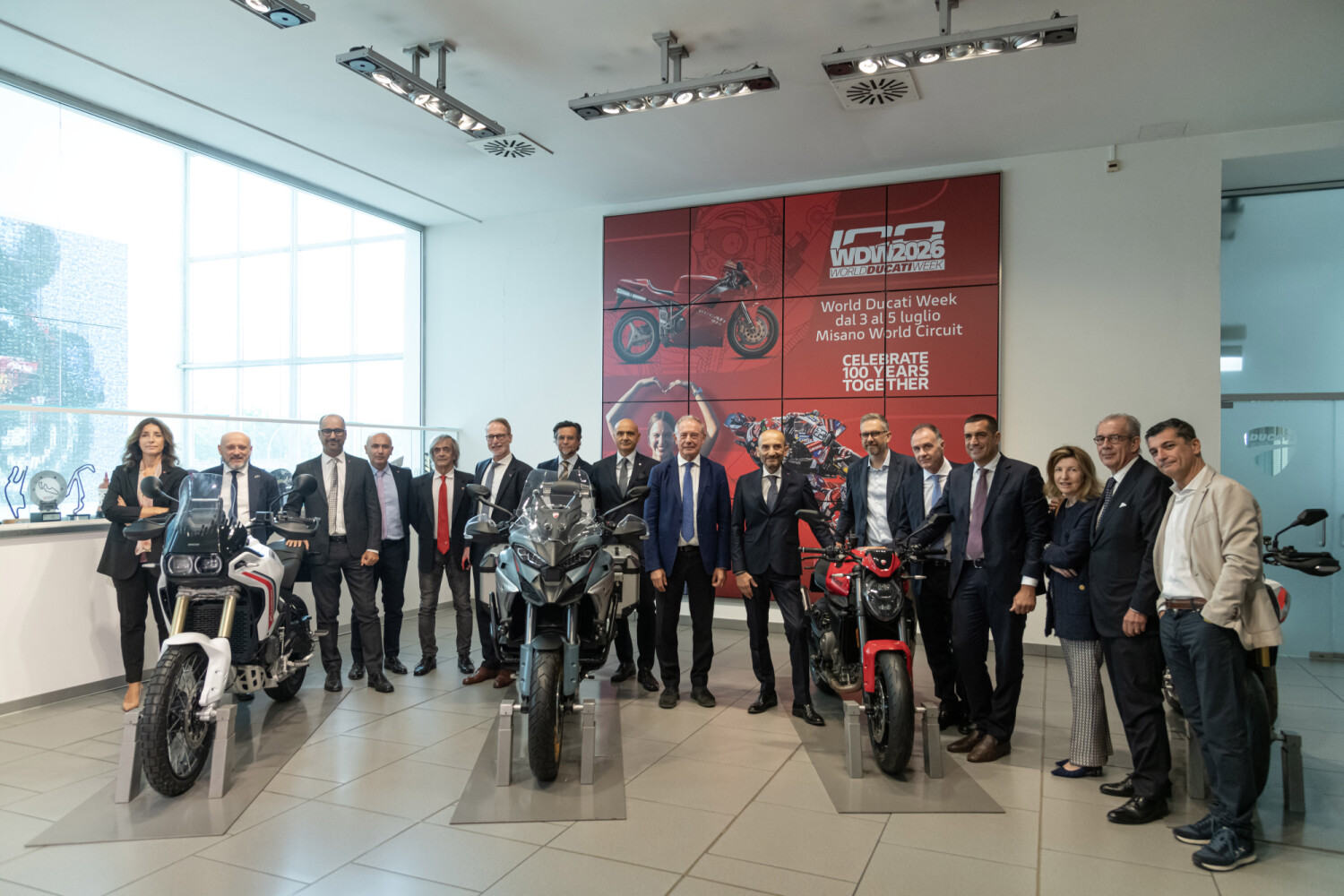
Ducati’s future has become a matter of open institutional attention in Italy. On 21 September 2026, Minister of Enterprises and Made in Italy Adolfo Urso visited the manufacturer in Borgo Panigale alongside Emilia-Romagna president Michele de Pascale, Bologna mayor Matteo Lepore and Confindustria president Emanuele Orsini. Tiziana Ferrari, director general of Confindustria Emilia Centro, also took part. The visit was held during Cersaie, the international exhibition for ceramics, architecture and bathroom furnishings taking place in Bologna.
The delegation met Ducati’s management and the company’s internal and provincial trade-union representatives from FIOM, FIM and UILM. The meeting framed Ducati as more than a motorcycle manufacturer: the company was presented as a significant part of Italy’s industrial system, with links to innovation, technical expertise, skilled employment and the territories around its plant. Ducati’s own description also connected its 100-year history with technological achievement, high-level sporting success and a distinctive design identity.
No formal sale decision
The political attention comes against the backdrop of news about a possible sale of Ducati. Urso said the government is following developments closely, but the company’s statement made the central qualification clear: no formal decision concerning a potential sale has been taken. The meeting therefore did not announce a change of ownership or identify a specific state intervention.
The shared institutional objective, as described by Ducati, is that any future development should preserve the growth path, investment and employment associated with the company’s current position. Urso said the government was prepared to use all available instruments to protect Ducati as a symbol of Made in Italy and the Motor Valley. He described the manufacturer as an expression of Italian technological and sporting achievement, as well as national identity and innovation.
De Pascale said the reaction to the sale-related news had been immediate and unified across what he called the wider Italian system. His emphasis was not limited to the Borgo Panigale facility: the supply chain around Ducati extends beyond the individual plant and involves several territories. In that context, he argued that the company’s future concerns a broader industrial network, not ownership viewed in isolation.
Ducati’s investment message
Chief executive Claudio Domenicali said the attention and support from the government, institutions and local area were a source of pride for Ducati. He added that the company generates the resources needed to finance a solid investment plan covering new products, facilities and IT systems. Ducati said this gives it confidence in maintaining the current technological leadership of its products, while presenting continued growth and innovation as the route that produced its recent results.
The institutional visit consequently leaves the ownership question open while making the political stakes more visible. Ducati said the meeting reflected a desire to keep dialogue going with all parties involved. For the Italian government and the regional institutions represented in Borgo Panigale, the manufacturer’s future is being treated as a priority for Emilia-Romagna, the Motor Valley and the country’s industrial system as a whole.
THE EVIDENCE BEHIND THE STORY
Sources
Spotted something that needs correcting? Contact the editorial team ↗